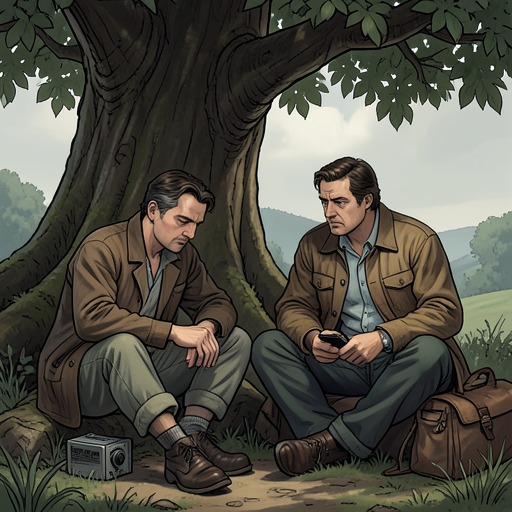
Michael and Kensuke
Kensuke's KingdomMichael and Kensuke’s relationship is the emotional centre of their island life: it begins with fear, prohibition, and a line drawn in sand, then grows through rescue, teaching, and daily companionship into a father-and-son bond. Its final test is whether care means keeping Michael close or helping him return to his parents. Kensuke ultimately lets him go, while choosing to remain among the orangutans he considers his family.
First Meeting and Uneasy Dependence
When Michael first encounters Kensuke, the old man is angry about Michael’s fire and orders him to stop. Kensuke draws a map of the island in the sand, marks the two hills, and separates the smaller end from the larger one. He identifies one side as his and assigns Michael the other, making their separation a visible rule rather than a mutual agreement. Michael leaves without arguing, but feels bewildered and betrayed: the stranger appears to have provided food and water, yet now forbids contact and extinguishes the fire.
The imbalance is sharpened by Michael’s dependence. After Kensuke orders him not to swim, Michael resents the restriction but obeys because he needs the old man’s food and water while waiting for a chance to signal a passing ship. Kensuke’s protection is therefore inseparable from control: he knows dangers Michael does not, but asserts his authority without initially explaining it. Michael’s sense of safety in his cave, which he has begun to think of as home, exists alongside the fear that he is marooned with a captor.
That conflict has roots in each character’s experience of danger. Michael remembers being alone in the ocean after the Peggy Sue disappeared into the darkness, convinced that no one could hear him. On the island he has survived, but still feels abandoned and fears his parents may never know what happened. Kensuke, meanwhile, has become wary of people after hunters came to the island, shot gibbons, and took their young. He came to think of people as killers and feared that anyone finding him might endanger the orangutans or take him away. His hostility toward Michael is thus not simply personal: it is a defensive response to the possibility that human arrival will bring violence again.
Rescue, Care, and a Shared Life
The relationship changes decisively after Michael is stung by jellyfish. Kensuke takes him from the sea, treats him with vinegar he has made from berries, and nurses him through a long period of illness. Michael wakes in Kensuke’s cave, unable at first to move, with Kensuke at his bedside and Stella close by. Kensuke gives him fruit juice and warm soup, cools him with water, and stays with him as he recovers. When Michael’s fingers move for the first time, Kensuke smiles. The man Michael had understood as his enemy and captor has become his saviour.
Care develops into instruction and shared work. As Michael regains his strength, Kensuke invites him to fish and makes a spear for him, showing him where fish and octopuses can be found and how to wait without frightening the fish away. He also shows Michael the forest’s food and the uses of its trees. Kensuke’s knowledge is practical and attentive: he knows which fruit is ripe, climbs to reach it, gathers honey, and moves through the forest among the orangutans that follow him. Michael is gradually included in these routines, first observing and then taking part.
Their companionship is not built on fluent conversation at first. Kensuke speaks little English, and the two rely on gestures, smiles, nods, and drawings in the sand. Painting and language lessons give this silence a new shape. Kensuke asks Michael to teach him English in exchange for teaching him painting; the lessons continue for months, as Michael names the world around them and Kensuke repeats and remembers the words. Kensuke’s first use of Michael’s name, in the form “Mica,” marks the shift from treating him as an intruder to addressing him personally. As communication grows, the friendship formed in silence becomes easier to express.
From Protection to Family
Kensuke eventually tells Michael how he came to the island and why he initially rejected him. He explains that he had lived alone for many years, learned survival by observing the orangutans, and hidden them when hunters arrived. After being carried away from the island by the sea, he heard Michael’s cries and found him, Stella, and the ball. He brought Michael back, left food and water, and then became angry when Michael lit a fire because he feared it would attract people. He also explains that he recognized the jellyfish as dangerous and rescued Michael after he was stung. His story changes the meaning of their earliest encounters: the same man who imposed rules had first saved Michael from the sea and tried to keep both the boy and the island’s animals safe.
Kensuke names the relationship directly when he tells Michael, “You are like son to me now.” He describes them as family and asks whether Michael agrees; Michael says yes, meaning it. Their life together has become a genuine source of happiness, grounded not only in affection but in painting, fishing, and the ordinary work of living together. Yet their closeness does not erase the difference between what each needs. Kensuke is settled on the island, while Michael longs to return home and let his parents know he is alive.
That difference becomes an ethical conflict after Michael secretly writes a message and puts it in a bottle. Kensuke is hurt that Michael did not tell him what he was feeling or planning, and calls the concealment dishonourable. But he also recognizes why Michael kept his wish to return home from him: Michael wanted both to stay with Kensuke and to go back to his parents, and knew that the truth would make Kensuke sad. Rather than treating the boy’s divided attachment as betrayal, Kensuke accepts its reality. He decides they will build a large fire to signal a ship and says they will play soccer together as they prepare. His care changes from trying to hold Michael apart from danger to helping him pursue the return he needs.
Parting and Continuing Bonds
When the Peggy Sue appears, Michael recognizes his parents aboard and turns to tell Kensuke. Kensuke is not at the lookout; he is sitting at the cave entrance with Michael’s soccer ball. He explains that he will not return to Japan. The world there has changed, he believes, and if his wife Kimi and son Michiya are alive, they may think he died long ago. He also has a family on the island: the orangutans, whom he believes may again be threatened by hunters. He calls the island Kensuke’s Kingdom and understands remaining there as a responsibility to the creatures in his care.
Kensuke’s decision gives the farewell its particular difficulty. He has become a father figure to Michael, but does not claim that this bond entitles him to keep the boy. Instead, he asks Michael for three promises: to paint every day, to think of him when he is home in England, especially when he sees the full moon, and to tell no one about Kensuke or the island for ten years. Michael promises. Kensuke then gives him the soccer ball and tells him that although he is good at soccer, he is a better painter.
The two part with a bow and Kensuke’s farewell, “Sayonara, Micasan.” Michael cannot answer aloud; he runs toward the beach while Stella follows, and watches the Peggy Sue come in for him. He says goodbye to Kensuke from the shore before running out to meet his parents. The ending does not dissolve their bond into reunion or erase the cost of separation. Instead, it gives that bond a continuing form: painting, memory, the shared full moon, and Michael’s promise of silence.
Narrative Significance
Michael and Kensuke’s relationship turns the island from a setting of isolation into a place where two stranded people make a life together, but it never makes their needs identical. Their story repeatedly tests the boundary between protection and possession: Kensuke’s rules initially exclude Michael, while his rescue and care establish why those rules matter; later, his decision to help Michael signal for a ship shows that responsible care must also make room for the other person’s future.
The relationship also joins two kinds of loss without pretending they are the same. Michael fears that his parents have lost him and wants to return to them; Kensuke carries the memory of Kimi and Michiya and has chosen a life apart from people. Calling one another family provides real comfort, but it does not replace Michael’s parents or persuade Kensuke to abandon the island. Their farewell is therefore not a rejection of their shared life. It is the final expression of it: Kensuke lets Michael go, and Michael carries the relationship forward by remembering him.